Personal Finance: A Beginner’s Guide to Managing Money
Let’s be honest—most of us never got a real class on money.
We learned algebra, the water cycle, maybe how to conjugate verbs in a language we forgot within a year. But how to actually manage money? That one usually got skipped.
So we figure it out the hard way. We overdraw an account. We rack up a credit card bill we didn’t see coming. We watch a paycheck disappear in a few days and have no idea where it went.
Sound familiar?
Here’s the good news: personal finance isn’t some mystical skill reserved for people who “get” numbers. It’s a collection of practical habits and ideas that, once they click, can genuinely reduce financial stress and help you make better decisions with your money.
This personal finance guide covers the basics—from understanding money and managing income to budgeting, saving, spending, debt, investing, and protecting your finances.
No unnecessary jargon. No lecture. Just the things that actually matter.
Quick Summary: Key Takeaways
- Personal finance is about habits, not just income: High earners can struggle without clear systems, while modest earners build wealth through deliberate choices.
- Multiple income streams build resilience: Relying on a single paycheck leaves you vulnerable; aim to build passive, rental, or investment income over time.
- Small spending compounds quickly: Untracked micro-expenses quietly cost thousands over a year.
- Debt is a tool, not a trap: Managed responsibly, borrowing can fund assets; managed poorly, high-interest debt drains your future wealth.
- Action step: Start with one manageable habit this week—such as listing your fixed expenses or building your first emergency buffer.
What is personal finance?
Personal finance is the way you manage your money and financial resources.
It covers the decisions you make about how you earn, spend, save, borrow, invest, and protect your money.
Personal finance isn’t only about how much money you make. It’s also about what you do with the money you have.
Someone with a high income can still struggle financially if they consistently spend more than they earn. At the same time, someone with a modest income can make meaningful financial progress by managing their money carefully, saving consistently, avoiding unnecessary debt, and investing appropriately.
Understanding the basics of personal finance can help you make more informed financial decisions and work toward your financial goals.
First, What Even Is Money?
Weird question, right? But it’s worth thinking about for a moment.
Money has value because people generally accept it in exchange for goods and services. Whether it’s a dollar, naira, euro, pound, or another currency, money provides a common way to exchange and measure value.
Money serves several important functions:
- It acts as a medium of exchange. Instead of directly trading goods and services with one another, we can use money to buy what we need.
- It serves as a unit of account. Money gives us a common way to measure and compare the value of different goods and services.
- It stores value. You can save money today and use it in the future, although inflation can reduce its purchasing power over time.
- It facilitates future payments. Loans, credit, and installment arrangements depend on money being used to settle obligations in the future.
One important thing to understand is that money’s purchasing power isn’t fixed.
When prices generally rise across an economy, we call it inflation. Your money can then buy fewer goods and services than it could previously. When prices generally fall, it’s called deflation, although sustained deflation is relatively uncommon in many economies.
This is one reason simply holding large amounts of cash for very long periods may not preserve your purchasing power. Over time, inflation can gradually reduce what that money can buy.
Sources Of Money: Where Does Your Money Come From?
Many people think of income as simply “my paycheck.” But income can come from several sources, and understanding those sources helps you see the different ways people can build financial security.
Earned Income
Earned income is money you receive from working. It includes salaries, wages, tips, commissions, and income from freelance or contract work.
For many people, earned income is their primary source of income.
Business Income
Business income is money generated by owning or operating a business.
What ultimately matters is the business’s profit after its relevant expenses have been accounted for.
Investment Income
Investment income is money generated from investments.
Depending on the investment, this might include dividends, interest, rental income, or capital gains when an asset increases in value and is sold.
Rental Income
Rental income is money received from allowing someone to use property or certain other assets you own, such as residential or commercial property.
Rental income isn’t necessarily pure profit. Property owners may have expenses such as maintenance, taxes, insurance, management costs, and financing costs.
Royalty Income
Royalty income is money received when someone pays for the right to use intellectual property or other assets covered by a royalty arrangement.
Examples can include books, music, patents, and certain licensed creations.
Transfer Income
Transfer income refers to money received without providing goods or services in direct exchange for that payment.
Depending on the country and circumstances, examples can include pensions, scholarships, government benefits, gifts, and remittances.
Active and Passive Income
You may also hear the terms active income and passive income
Active income generally requires ongoing participation in work or a business.
Passive income is often used to describe income that can continue with less day-to-day involvement after an asset or system has been established.
However, “passive” doesn’t necessarily mean effortless.
Rental properties require management, investments require monitoring, and businesses can require significant ongoing work.
The bigger lesson is this: relying on a single source of income can leave you financially vulnerable. As your circumstances allow, developing additional sources of income or building productive assets can increase your financial resilience.
How to Manage Your Money
Earning money is only part of personal finance.
Someone can earn a high income and still struggle financially if they consistently spend more than they earn, take on excessive debt, or fail to save and invest.
The goal isn’t simply to earn more. It’s to manage what you earn effectively.
Good money management involves setting financial goals, creating a budget, controlling spending, saving consistently, managing debt, investing appropriately, and protecting yourself from financial risks.
Start With a Financial Goal, Not a Spreadsheet
Before you build a budget, get clear about what you’re actually trying to accomplish.
Financial goals often fall into three broad categories:
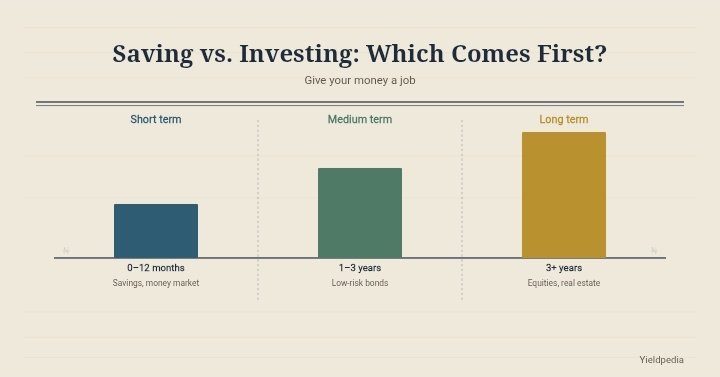
- Short-term goals — usually goals you expect to achieve within a year, such as building an initial emergency fund or paying off a small debt
- Medium-term goals — often goals that may take one to five years, such as buying a car, starting a business, or paying for professional training.
- Long-term goals — goals that may take more than five years, such as buying a home, preparing for retirement, or funding a child’s education.
Your timeline may differ depending on your circumstances, but the principle is simple: give your money a purpose.
It’s much easier to stay motivated when you’re saving toward a specific goal than when you’re simply telling yourself to “save more.”
Budgeting: A Boring Word With a Useful Purpose
Let’s be honest: “budget” can sound like a punishment.
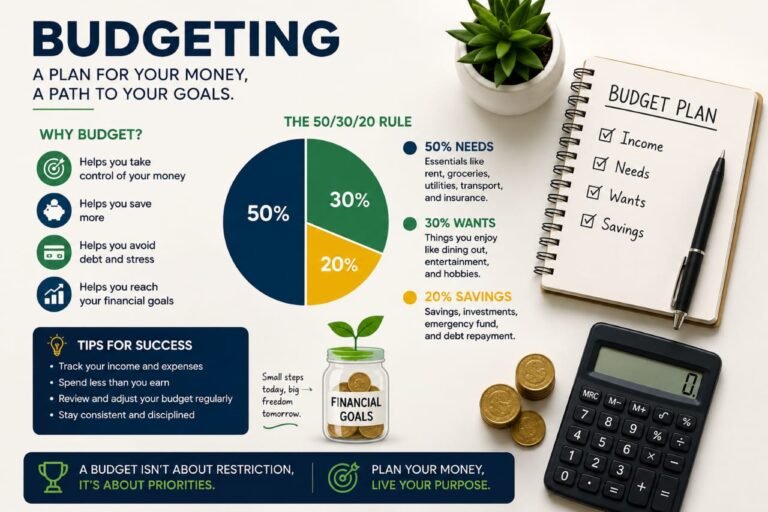
But a budget is really just a plan for how you intend to use your money.
The basics are straightforward:
- Add up your income.
- List your regular expenses.
- Separate essential expenses from discretionary spending.
- Decide how much you want to save, invest, or use toward debt repayment.
- Compare what is coming in with what is going out.
- Review the plan regularly and make adjustments when your circumstances change.
Your budget isn’t a stone tablet. Income, expenses, priorities, and circumstances change.
The purpose of budgeting isn’t to eliminate every enjoyable purchase. It’s to give you visibility and control over your money.
You can’t effectively manage what you don’t know you’re spending.
Saving: Paying Your Future Self First
Saving gives you a financial buffer.
Unexpected expenses happen. Your car may need repairs. Your income could temporarily decrease. An important bill might arrive at the worst possible time.
Without savings, an unexpected expense can force you to borrow money or sell investments at an inconvenient time.
You don’t need to save a huge amount to get started. Consistency matters.
For example, setting aside a modest amount every week or month can gradually build a meaningful financial cushion.
The important thing is to make saving a habit rather than something you only do when you happen to have money left over.
Spending: The Quiet Wealth Killer
Here’s an uncomfortable truth: earning a good income doesn’t automatically make you financially secure.
If your spending continually rises alongside your income, you can find yourself earning more without actually becoming much wealthier.
Managing expenses doesn’t mean never buying anything enjoyable. It means spending intentionally.
That can include:
- Covering essential needs before discretionary wants.
- Tracking where your money goes.
- Being cautious about impulse purchases.
- Reviewing recurring expenses and subscriptions.
- Paying attention to fees and charges.
- Avoiding lifestyle increases that you cannot comfortably afford.
Small expenses can become significant when they are repeated frequently
For example, spending the equivalent of $15 five times a week would amount to $75 a week and roughly $3,900 over a full year.
The lesson isn’t that every small purchase is bad. It’s that repeated spending deserves attention.
Debt: A Tool That Requires Discipline
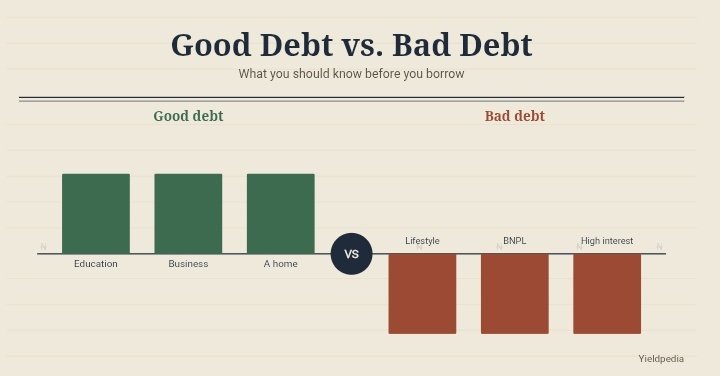
Debt isn’t automatically good or bad.
Borrowing can sometimes help you achieve an important financial goal—for example, financing education, purchasing a home, or expanding a productive business. But debt can also become a serious financial burden when borrowing is excessive or poorly managed.
Good debt management starts with understanding what you’re borrowing, how much it will cost, and whether you can realistically repay it.
Useful habits include:
- Borrowing only what you can reasonably afford to repay.
- Understanding the interest rate and other borrowing costs.
- Making payments on time.
- Avoiding unnecessary high-cost debt.
- Paying more than the minimum when it makes financial sense and you can afford to do so.
- Keeping track of your total debt rather than looking at each loan or credit balance in isolation.
The key isn’t to fear all debt. It’s to treat borrowing as a financial responsibility, not free money.
Investing: Giving Your Money a Chance to Grow
Saving and investing are related, but they’re not the same thing.
Saving is generally focused on preserving money and keeping it available when you need it.
Investing involves putting money into assets with the expectation of generating a return over time. Examples can include stocks, bonds, mutual funds, exchange-traded funds (ETFs), real estate, and other investment assets.
Investing comes with risk. The value of investments can rise or fall, and some investments can lose money.
That means investing isn’t simply about finding something that will “make money.” It’s about understanding risk, return, time horizon, diversification, fees, and your own financial circumstances.
One of the biggest advantages an investor can have is time.
Starting early can give your money more opportunity to benefit from compounding—the process in which returns can generate additional returns over time.
Protecting It All: Risk Management
This is the part people often overlook—until they need it.
Life is unpredictable. An accident, major repair, illness, loss of income, or other unexpected event can disrupt even a well-organized financial plan.
Risk management is about reducing the financial impact of events you cannot fully predict or control.
Depending on your circumstances, this can include:
- Building an emergency fund.
- Having appropriate insurance.
- Avoiding excessive debt.
- Diversifying investments where appropriate.
- Protecting important assets.
- Having a plan for periods of reduced income.
- Regularly reviewing your financial arrangements.
The goal isn’t to eliminate every possible risk. That’s impossible.
The goal is to make sure that one unexpected event doesn’t completely destroy your financial progress.
Check In With Yourself—Financially
Your finances deserve regular attention.
Once a month, take some time to review:
- How much money came in.
- How much you spent.
- How much you saved.
- How much debt you owe.
- Whether you’re making progress toward your goals.
- How your investments are performing, if you have any.
- Whether your financial priorities have changed.
You don’t need to spend hours doing this.
A simple monthly review can help you identify problems early, before they become much harder to fix.
The Financial Mistakes Almost Everyone Makes
If any of these sound familiar, you’re definitely not alone:
- Spending more than you earn.
- Never creating a realistic budget.
- Ignoring small purchases that add up over time.
- Saving only when there’s money left over.
- Borrowing for things you don’t really need.
- Having little or no emergency savings.
- Delaying investing indefinitely.
- Taking investment risks you don’t understand.
- Failing to review your financial situation regularly.
The interesting thing is that most financial problems don’t begin with one dramatic mistake.
They often develop through small habits repeated over a long period
The good news is that the reverse is also true.
Small, consistent financial habits can compound in your favour
Saving regularly, controlling unnecessary expenses, reducing expensive debt, investing appropriately, and increasing your financial knowledge may not feel dramatic today—but over time, they can make a significant difference.
The Bottom Line
Personal finance isn’t about being a genius with numbers.
It’s about developing a few practical habits and applying them consistently:
- Know where your money comes from.
- Plan where it goes.
- Spend intentionally
- Save for the unexpected.
- Borrow carefully.
- Invest according to your goals and risk tolerance.
- Protect what you’ve built.
- Review your finances regularly.
None of this is necessarily complicated.
The difficult part is making these habits consistent.
And that’s exactly why personal finance deserves more attention. You don’t need to become a financial expert overnight.
Start with one thing—perhaps tracking your spending this month, building your first emergency fund, or creating a simple budget.
Learn one skill, put it into practice, and then build from there.
That’s how financial knowledge becomes financial progress.