How to Create a Budget That Actually Works: The Complete Guide
You get paid. You pay a few bills. You buy some food. You send money to someone. You spend a little here and there.
Then, somehow, the money is gone.
You check your account and wonder: Where did everything go?
That’s one of the problems a budget is designed to solve.
A budget isn’t about making your life miserable or telling you that you can’t enjoy your money. It’s simply a plan for your money before you spend it.
Without a plan, it’s easy for small expenses to become big expenses. You may save whatever is left at the end of the month, only to discover that there isn’t much left.
A budget gives your money somewhere to go.
.
Quick Summary: Budgeting Basics
- A budget is a plan: It tells your money where to go before you spend it.
- Start with your real income: Include salary and other reliable sources of income.
- Separate needs from wants: Not every expense deserves the same priority.
- Know your numbers: Track your essential expenses, debt payments, savings and discretionary spending.
- Use budgeting rules as guides: The 50/30/20 rule can help, but it doesn’t have to fit everyone’s situation.
- Give saving a place in your budget: Don’t wait to see what’s left over.
- Review regularly: A budget should change as your income, expenses and responsibilities change.
A quick note for international readers: The examples in this article use Nigerian naira (₦), but the principles apply regardless of where you live. Simply substitute your local currency and adjust the figures to reflect your own income and living costs.
What Exactly Is a Budget?
A budget is a plan for how you intend to use your money over a specific period, usually a month.
Some of your money may go toward rent, food and transportation. Some may go toward debt payments. Some may be saved for emergencies or future goals. And some can be used for things you simply enjoy.
The point isn’t to spend less on everything.
The point is to spend intentionally.
Think of your budget as a map. You don’t create a map because you expect to get lost. You create one because knowing where you’re going makes the journey easier.
Why You Actually Need a Budget
You don’t need a budget because someone on the internet said you should have one.
Imagine you earn ₦300,000 every month.
You pay rent, buy food, use transportation, pay bills, send money to family, subscribe to a few services, eat out occasionally and make other small purchases.
None of those expenses may look particularly serious on their own.
But together, they can consume most or all of your income.
Without tracking them, you may think your problem is that you don’t earn enough when part of the problem is simply that your money doesn’t have a clear plan.
A budget can help you:
- Control unnecessary spending
- Prepare for upcoming expenses
- Build an emergency fund
- Reduce or avoid unnecessary debt
- Save toward specific goals
- Understand whether your income is enough for your lifestyle
- Make better financial decisions
A budget doesn’t automatically increase your income.
It helps you make better use of the income you already have.
Start With How Much You Actually Earn
Before creating a budget, you need to know how much money you’re working with.
If you’re employed and earn a regular salary, this is relatively straightforward.
But don’t confuse your gross income with the money that actually reaches your account.
If deductions such as taxes, pension contributions or other payroll deductions are taken from your salary, your budget should generally be based on the amount you actually have available to spend.
For people with side businesses, freelance work or irregular income, things can be more complicated.
In that situation, don’t build your lifestyle around your best month.
If your income varies between ₦200,000 and ₦400,000, it may be safer to build your basic budget around a conservative income level and treat unusually high income as an opportunity to save, invest, pay debt or prepare for future expenses.
Know Where Your Money Goes
Once you know your income, look at your expenses.
A useful starting point is to divide them into three broad groups:
- Essential Expenses
These are expenses you need to maintain your basic life and responsibilities.
Examples include:
- Food
- Rent
- Transportation
- Utilities
- Basic healthcare
- Insurance
- Necessary debt payments
2. Financial Goals
This includes money you’re deliberately putting toward your future.
Examples:
- Emergency fund
- Investments
- Retirement
- Education
- House deposit
- Business capital
3. Wants and Discretionary Spending
These are things you may enjoy but could generally live without.
Examples include:
- Eating at restaurants
- Entertainment
- New clothes you don’t need
- Streaming subscriptions
- Hobbies
- Unplanned shopping
There’s nothing wrong with spending money on wants.
The problem starts when your wants consistently consume money meant for your necessities or financial goals.
Needs vs. Wants: It’s Not Always Obvious
The difference between a need and a want isn’t always black and white.
Food is a need.
Ordering expensive food every weekend is a choice.
Transportation is a need.
Taking a more expensive option when a cheaper reasonable option is available may be a want.
A phone may be necessary for work.
Buying the newest phone every year isn’t necessarily necessary.
The goal isn’t to eliminate wants. It’s to understand them.
Once you know what is essential and what is optional, you can make decisions without pretending every expense is equally important.
How to Create Your First Budget
You don’t need complicated software to start.
You can use a notebook, spreadsheet or budgeting app.
Follow these steps.
Step 1: Write Down Your Income
Start with the amount of money you actually expect to receive.
For example:
Monthly income: ₦300,000
If your income changes, use a conservative estimate rather than assuming you’ll have an unusually good month.
Step 2: List Your Essential Expenses
Write down what you need to pay each month.
Don’t guess if you can check your bank statements or previous spending.
Step 3: Add Your Financial Goals
Decide how much you want to save or invest.
Even if the amount is small, give it a place in the budget.
Saving shouldn’t always be:
“I’ll save whatever is left.”
Sometimes there won’t be anything left.
Step 4: Allocate Money for Wants
Give yourself some room to enjoy your money.
A budget that leaves absolutely no room for enjoyment can be difficult to maintain.
The goal is balance, not punishment.
Step 5: Subtract Your Planned Expenses From Your Income
Your numbers should make sense.
If your planned expenses are higher than your income, something has to change.
You either need to reduce expenses, increase income, or both.
Step 6: Track What Actually Happens
Creating a budget is only half the job.
You also need to compare your plan with reality.
If you planned to spend ₦30,000 on transportation but consistently spend ₦45,000, your budget needs to reflect reality.
A budget shouldn’t be a document you create on the first day of the month and forget about.
A Simple ₦300,000 Monthly Budget Example
Let’s say someone earns ₦300,000 per month.
Their budget might look like this:
| Category | Monthly Amount |
| Rent allocation | ₦70,000 |
| Food | ₦55,000 |
| Transportation | ₦30,000 |
| Utilities | ₦15,000 |
| Healthcare/insurance | ₦10,000 |
| Debt payment | ₦20,000 |
| Emergency fund/savings | ₦40,000 |
| Personal spending | ₦30,000 |
| Investment/long-term goals | ₦20,000 |
| Total | ₦290,000 |
That leaves ₦10,000 unallocated.
It could become additional savings, investment money, a buffer for unexpected expenses or simply remain available for the month.
Notice that this isn’t presented as the correct budget for everyone earning ₦300,000.
Someone paying higher rent may need a completely different allocation.
Someone with no debt may have more money available for saving or investing.
Someone supporting several family members may have significantly higher essential expenses.
The purpose of the example is to show how the pieces can fit together.
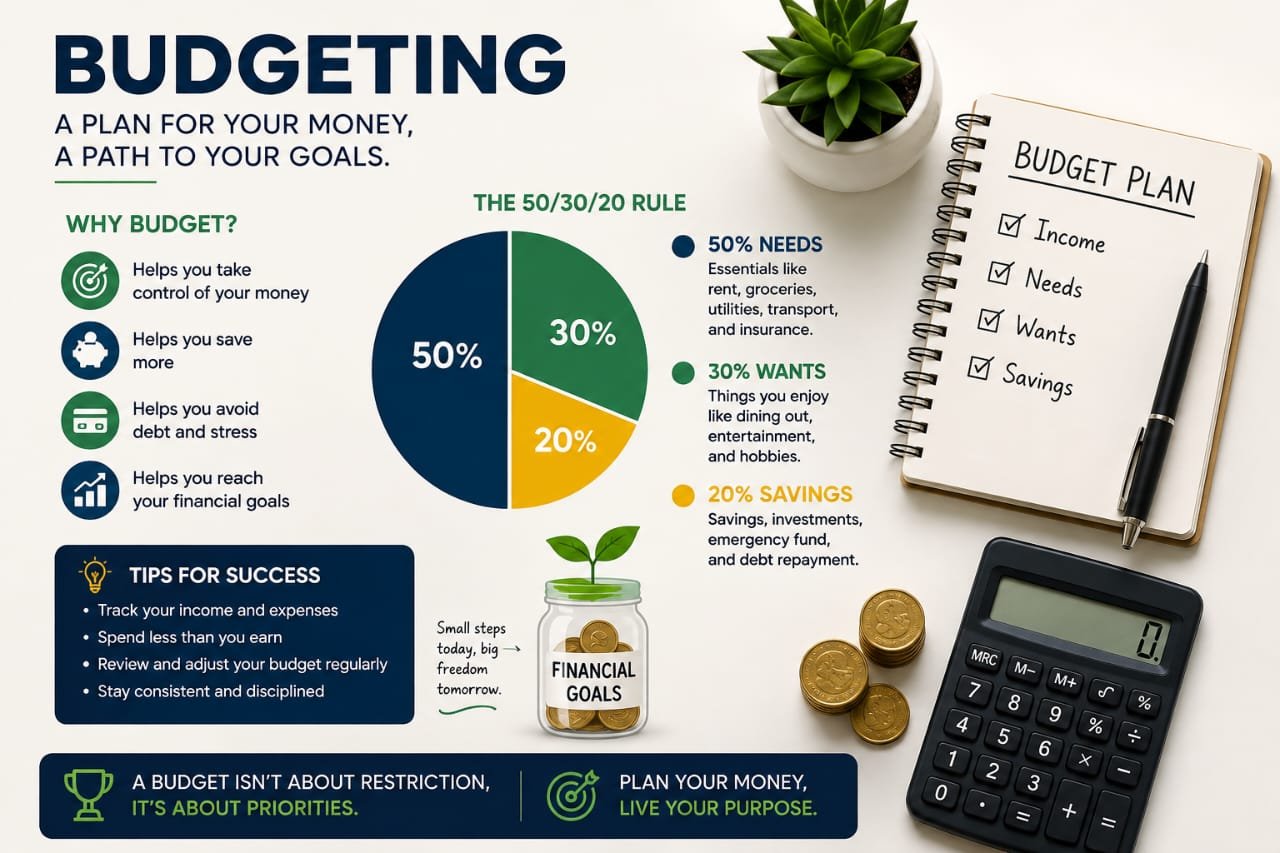
What About the 50/30/20 Rule?
You’ve probably heard of the 50/30/20 rule.
The basic idea is to divide after-tax income roughly into:
- 50% for needs
- 30% for wants
- 20% for savings and financial goals
It’s a useful starting framework.
But don’t treat it like a law.
If you’re living in an expensive city, supporting a family, paying off significant debt or earning a relatively low income, your numbers may look very different.
The important thing isn’t whether your budget looks exactly like a popular formula.
The important thing is that your spending reflects your actual circumstances and priorities.
What If Your Income Changes Every Month?
Budgeting can be harder when your income isn’t predictable.
This is common among freelancers, business owners, commission-based workers and people with multiple income sources.
One approach is to build your basic lifestyle around your lower or more reliable income.
For example, if your monthly income varies significantly, don’t assume your highest month will repeat.
When you have a particularly good month, you can direct the extra money toward:
- Emergency savings
- Debt repayment
- Investments
- Upcoming expenses
- Business capital
This can help prevent lifestyle inflation, where your spending rises every time your income rises.
How to Budget When You Don’t Earn Much
This is where budgeting can feel frustrating.
If you’re earning ₦150,000 and your essential expenses are already ₦130,000, someone telling you to “just save 20%” isn’t particularly helpful.
Sometimes the problem isn’t poor budgeting.
Sometimes the income simply isn’t enough for the expenses.
A budget can help you identify that difference.
If your essential expenses consistently exceed your income, cutting small expenses may help, but increasing income may eventually become necessary.
That could mean:
- Developing a valuable skill
- Taking on additional work
- Growing a small business
- Negotiating better pay
- Finding new income sources
Budgeting isn’t only about cutting expenses.
It’s also about understanding your financial reality.
Common Budgeting Mistakes
Budgeting With Unrealistic Numbers
If you consistently spend ₦50,000 on food, putting ₦20,000 in your budget doesn’t solve the problem.
It simply creates a budget that doesn’t reflect reality.
Forgetting Irregular Expenses
Some expenses don’t happen every month.
School fees, annual insurance, repairs, gifts and other periodic expenses can still be planned for.
You can estimate the yearly cost and set aside money gradually.
Saving Only What’s Left
If saving is important to you, include it in the plan.
Don’t always wait until the end of the month.
Making the Budget Too Complicated
You don’t need twenty-five categories to know where your money is going.
Start simple.
You can always make the system more detailed later.
Treating the Budget as Permanent
Your life changes.
Your income changes. Your rent changes. Your responsibilities change.
Your budget should change too.
Budgeting vs. Saving: What’s the Difference?
Budgeting and saving work together, but they aren’t the same thing.
Budgeting is deciding where your money should go.
Saving is setting money aside for future use.
For example, your budget might say:
“I’ll save ₦40,000 this month.”
The saving is the action.
The budget is the plan that makes room for that action.
You need both if you want to consistently build savings.
How Often Should You Review Your Budget?
You don’t have to rebuild your entire budget every day.
But you should review it regularly.
A quick check once a week can help you see whether you’re spending faster than planned.
At the end of the month, compare:
What you planned to spend vs. what you actually spent.
Don’t use this exercise to beat yourself up.
Use it to learn.
If transportation was higher than expected, find out why.
If you spent less on food, understand what changed.
If you couldn’t save the amount you planned, identify what prevented it.
Your budget becomes more useful as it becomes more accurate.
What Happens When You Go Over Budget?
You will.
Probably more than once.
Going over budget doesn’t mean budgeting has failed.
The important thing is to understand why it happened.
Was it an actual emergency?
Was the expense something you forgot to plan for?
Did you underestimate the cost?
Or was it simply an impulse purchase?
The answer matters because each situation requires a different response.
If the same expense keeps appearing, it may belong in your normal budget rather than being treated as an unexpected expense every month.
The Bottom Line
A budget isn’t a restriction on your money.
It’s a way of giving your money direction.
You don’t need a perfect spreadsheet. You don’t need a high income. And you don’t need to follow someone else’s budgeting formula exactly.
Start with what you earn.
Understand what you need to spend.
Separate your wants from your necessities.
Make room for saving and your other financial goals.
Then track what actually happens and adjust.
Your first budget probably won’t be perfect.
That’s okay.
A budget that you understand and actually use is more valuable than a perfect budget that you abandon after one month.