Good Debt vs. Bad Debt: What You Should Know
Debt has a bad reputation, and it’s easy to see why. You borrow money today and pay it back tomorrow, with interest tacked on. But debt isn’t automatically bad. A loan can help you pay for an education, start a business, buy a home, or acquire something that improves your ability to earn — and the same borrowing can turn into a problem the moment you’re using it to fund things you can’t actually afford.
So the better question isn’t “is debt good or bad?” It’s: what is this debt costing me, what is it helping me achieve, and can I comfortably repay it? That’s what this article walks through.
Quick Summary
- Debt isn’t automatically good or bad — productive borrowing can improve your position, expensive consumer debt can make things worse.
- The interest rate matters, but so do the fees and repayment terms.
- Don’t judge a loan by the amount you’re receiving. Judge it by what you’re borrowing for and what you’ll actually have to repay.
- Make sure the repayment fits comfortably within your income, not just on paper.
- Before borrowing, understand the total cost and what happens if your income drops.
What Exactly Is Debt?
Debt is money you owe to another person or institution. You receive money, goods, or services now, and agree to repay what you owe on specific terms — usually with interest or fees attached.
Say you borrow ₦500,000 and agree to repay ₦600,000 over time. The ₦500,000 is what you borrowed; the extra ₦100,000 is the cost of borrowing it. That distinction matters more than people usually give it credit for — the amount you borrow and the amount the debt ultimately costs you are two different numbers.
Why Do People Borrow Money?
People borrow to pay for education, start or expand a business, buy a home or a car, purchase equipment, cover medical expenses, handle an emergency, fund everyday spending, or simply buy something they want but can’t currently afford.
The purpose matters, but it isn’t the whole story. A business loan isn’t automatically “good” just because it’s for a business — if the business doesn’t generate enough cash to cover it, the debt is still a problem. Likewise, education debt isn’t automatically bad if the education meaningfully improves your earning potential. The numbers and the circumstances decide, not the category.
What Counts as Good Debt?
“Good debt” generally describes borrowing with a reasonable chance of improving your financial position or moving you toward an important long-term goal. That said, good debt still isn’t guaranteed to produce a good outcome — it just tends to have better odds.
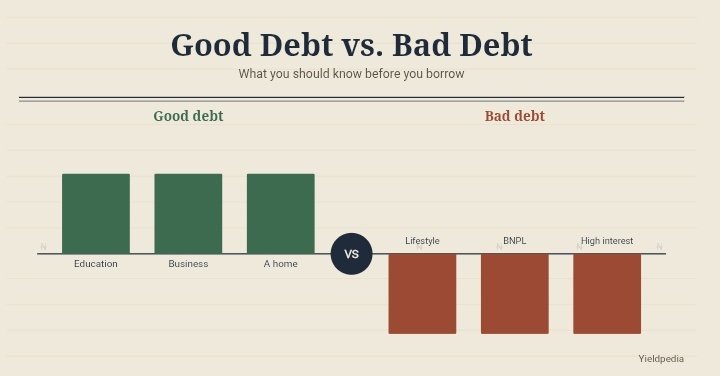
Education: Borrowing for education or professional training can make sense when it meaningfully improves your skills and future earning potential. But weigh the cost. Borrowing ₦2 million for a qualification that doesn’t materially improve your job prospects may not pay off, no matter how worthy the subject felt going in.
Business: Borrowing can help a business buy equipment, build inventory, expand, or seize an opportunity — as long as there’s a realistic path to generating enough cash to repay it. Borrowing ₦5 million to expand a business that’s already profitable is a very different bet than borrowing ₦5 million because you hope the business becomes profitable someday.
A home: A mortgage can help you buy an appreciating asset while spreading the cost over years. But ownership comes with more than the monthly repayment — maintenance, insurance, taxes, and service charges all add up. Don’t judge affordability by the mortgage payment alone.
Income-producing assets: Borrowing to acquire an asset that’s meant to generate income can make sense if the expected returns comfortably outweigh the cost and risk. Just remember that projected returns and actual returns aren’t the same thing — plenty of investments look great on paper and underperform in practice.
What Counts as Bad Debt?
“Bad debt” generally describes borrowing that provides little or no lasting benefit while creating a real repayment burden. The classic example: buying an expensive phone on credit because you can’t afford it outright. The phone doesn’t generate income or improve your financial position — but you still owe the money, plus interest and fees.
High-interest consumer debt is particularly dangerous because the higher the cost of borrowing, the harder it is to get ahead. If you’re paying significant interest every month, part of your future income is already spoken for before you even earn it.
Borrowing for lifestyle spending tends to create its own cycle: you spend more than you earn, borrow to cover the gap, and then have to repay that borrowing out of an income that’s now smaller because part of it is committed to repayments. Eventually you borrow again just to keep up. That’s how short-term borrowing quietly becomes a long-term problem.
Is It Really That Simple?
Not quite — the labels can be misleading if you lean on them too hard.
Take two people who each borrow ₦1 million. Person A buys equipment for a business that already has paying customers and enough cash flow to service the loan comfortably. Person B uses the money to fund a lifestyle they can’t afford, with no real plan for repayment. Same amount, completely different situations.
So instead of asking “is this good debt?”, ask: What am I borrowing for? How much will it actually cost? Can I afford the repayment? What benefit does it provide? What happens if my income falls? Is there another way to reach the same goal without borrowing at all? Those questions do more work than the label ever will.
The Interest Rate Isn’t the Whole Story
Borrowing ₦500,000 doesn’t tell you much on its own. You also need to know the interest rate, how that interest is calculated, the repayment period, the monthly payment, processing fees, insurance or other charges, penalties, and the terms around early repayment.
Two loans offering the identical ₦500,000 can have very different total costs. Say Loan A comes to ₦575,000 in total repayment, while Loan B comes to ₦700,000 — same amount upfront, but Loan B costs you considerably more. If the purpose behind both loans is the same, the cheaper one is usually the better pick, assuming the other terms line up too. This is exactly why comparing loans by the amount you receive, rather than the amount you’ll repay, can lead you astray.
Can You Actually Afford It?
This might be the most important question of all. Say you earn ₦300,000 a month and a new loan asks for ₦100,000 in monthly repayments. On paper, that works. But what’s left after rent, food, transport, utilities, and everything else essential? If the answer is “almost nothing,” the loan is probably too large for your situation — and that’s before accounting for what happens if your income dips.
Affordability isn’t “can I make the payment this month?” It’s whether you can handle that repayment without putting your entire financial life under strai
Don’t Skip the Emergency Fund
This is where an emergency fund earns its keep. Without one, an unexpected expense can force you into borrowing you didn’t plan for. If your car needs a ₦200,000 repair and you have no savings, that repair becomes a loan — and the loan becomes another monthly obligation on top of everything else. A solid emergency fund cuts down how often you’re forced into expensive borrowing just to handle life’s surprises. (For more on this, see our guide on Emergency Fund: How Much Should You Save and Where Should You Keep It?)
Should You Save Instead of Borrow?
Sometimes the real choice isn’t borrow-or-don’t — it’s borrow-or-save. If something costs ₦300,000, you could take a loan and repay it over time, or save ₦50,000 a month for six months and buy it outright. Which is better depends entirely on the situation. An urgent medical expense won’t wait six months. A new television usually can.
Before taking a loan, it’s worth asking yourself plainly: do I need this now, or do I just want it now? That one question alone prevents a lot of unnecessary debt.
Credit Cards and Buy Now, Pay Later
These can be genuinely convenient, but convenience has a way of making spending feel less real. Seeing ₦100,000 leave your account all at once stings; seeing it split into four smaller payments doesn’t — even though you owe exactly the same amount either way. Before using credit or a BNPL service, know the total you’ll repay, the interest charges, the fees, what happens if you’re late, and what happens if you miss a payment entirely. “Small monthly payments” can make an expensive purchase look affordable when the real total tells a different story.
When Debt Becomes a Problem
Some warning signs are worth taking seriously: borrowing to repay another loan, frequently missing payments, using new debt to cover everyday expenses, paying only the minimum while balances keep growing, taking loans without knowing the total repayment, relying on debt for necessities month after month, or having little left over once debt payments are made.
If several of these sound familiar, taking another loan probably won’t fix the underlying issue. It’s worth stepping back, getting a clear picture of the numbers, and building an actual plan to bring the debt down.
How to Pay Down Debt You Already Have
Start with a simple list: who you owe, how much, the interest rate, the minimum payment, the due date, and how much time is left on each. Once it’s all in front of you, two common strategies can help:
- Debt avalanche — put extra payments toward the highest-interest debt first while covering minimums on the rest. This saves the most money in interest over time.
- Debt snowball — pay off the smallest balance first, then roll that payment into the next one. It saves less in interest but gives you visible wins early, which for a lot of people is what actually keeps the plan alive.
Neither one makes debt disappear on its own. What matters is picking a plan and sticking to it.
Common Debt Mistakes Worth Avoiding
- Borrowing more than you need: A lender offering you ₦2 million doesn’t mean you should take ₦2 million. Borrow what’s necessary and what you can reasonably repay.
- Focusing only on the monthly payment: ₦50,000 a month sounds manageable — until you account for how many months you’ll be paying it. Look at the total.
- Ignoring the interest rate: The amount borrowed is never the full cost.
- Borrowing to keep up appearances: A lifestyle funded by debt can look fine from the outside. The repayments stay invisible right up until they aren’t.
- Taking new debt to cover old debt without a plan: Consolidation and refinancing can help, but only if the underlying spending habits and cash flow actually change — otherwise you’re just moving the same problem around.
- Not reading the terms: Understand what you’re agreeing to before the money hits your account, not after.
Before You Borrow, Ask Yourself
What am I borrowing for — a need or a want? How much will I repay in total, and at what interest rate, with what fees? Can my current income comfortably handle the payment, and what happens if it drops? Do I have an emergency fund? Could I save for this instead? Will this actually improve my financial position, or just get me something I want right now?
You don’t need a perfect answer to every question. You just need to understand what you’re signing up for.
The Bottom Line
Debt isn’t automatically your enemy. Used carefully, it can help you pay for education, acquire productive assets, grow a business, or reach other real goals. It can also get expensive fast when it’s funding a lifestyle you can’t afford or taken on without understanding the true cost.
The point isn’t to memorize a list of “good debts” and “bad debts.” Look at the purpose, the cost, the repayment terms, and your actual ability to repay. If the debt moves you toward something that matters and you can manage the payments without strain, it’s probably worth it. If you’re borrowing simply because you don’t have the money for something you don’t really need, saving is usually the better call.
You don’t have to avoid debt altogether. You just need to understand exactly what you’re taking on — and make sure it doesn’t end up controlling your future.